Using a collection of the Sidney Family letters printed in the 17th century Visualizing the Sidney Network uses network analysis to visualize and contextualize the Dudley-Sidney network using an extensive collection of letters. This project will highlight the important place of women in family and political networks and be a resource for scholars in history, literature, early modern and British studies.
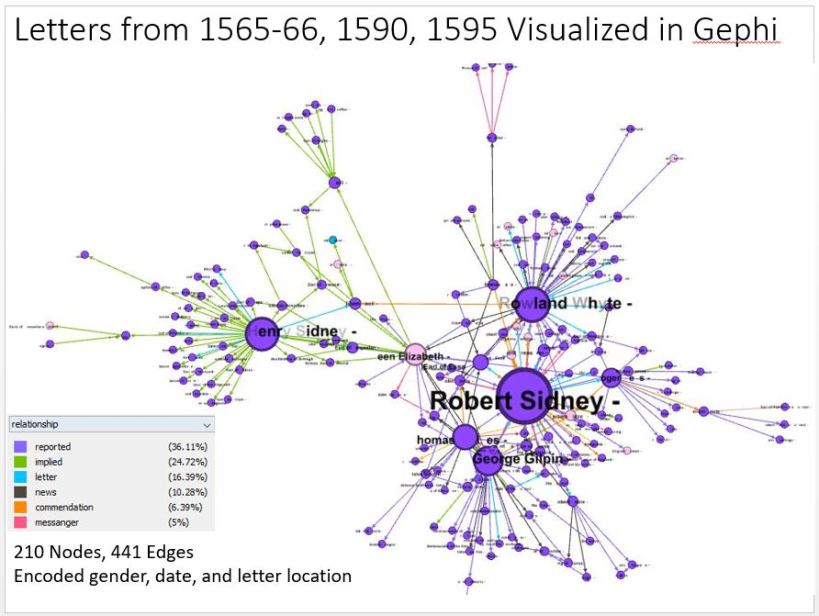
The Sidney family were influential in politics and literature in Tudor and Stuart England. Henry Sidney’s political service to Queen Elizabeth and his son’s Philip’s renown as a poet and tragic early death and subsequent generations following within this tradition have made the family prominent within the study of early modern England. However, it was not just the male members of the family who created this political and literary legacy, Sidney women were central to this work. While this has been acknowledged in the family literary legacy, women and their roles in politics has been overlooked. However, the women of the family were central participants.
Because of the prominent role of the Sidney family, their political and literary networks have been studied by scholars. These studies have not used network analysis technologies, but have been created manually. While these studies have shown the important of the Sidney network in early modern literature and politics and have begun to hint at the intertwined nature of political and literary networks, these studies often leave out the place of women in political networks and the political aspects of their involvement in literary networks.
Examining the network using network analysis provides the opportunity to see the place of women within the network and to better understand the network. The developing field of network analysis has shown the power of this type of modeling to highlight relationships, which in the case of the Sidney network should show the place of women and other lesser known figures within the network.
The source material for this project is Sidney family letters collected, edited, and published by Arthur Collins in 1746 as Letters and Memorials of State: in the Reigns of Queen Mary, Queen Elizabeth, King James, King Charles the First, Part of the Reign of King Charles the Second, and Oliver’s Usurpation, a two-volume work. He utilized records from the Sidney family seat at Penshurst in Kent as well as the Office of Papers and Records for Business of State from the time of Sir Henry Sidney’s Lord Deputyship in Ireland in 1577 to Robert Sidney and his brother Algernon in the 1660s. Transcriptions of Sidney letters comprise the bulk of the two volumes of Letters and Memorials Collins stated that the letters share information on various negotiations with foreign powers, “intrigues of the several courts of Queen Elizabeth, King James, and King Charles the First,” as well as “some remarkable transactions, both at home and abroad, during those times, not hitherto known.”[1] Henry Sidney’s letters, especially during his times serving as Lord Deputy of Ireland, comprise a majority of the first volume of Letters and Memorials. The first and second volumes also contain many letters written between Henry’s son Robert Sidney and his Secretary Rowland Whyte while Robert was serving on diplomatic missions throughout Europe, particularly in the Netherlands. These letters shed light on the “news and intrigues of court” and English foreign policy during the end of the reign of Elizabeth I and the early reign of James I.[2] The letters of the first two generations of the Sidney family thus make up the great majority of the content in Letters and Memorials. Initially this project will use the letters from the reign of Elizabeth I 1558-1603. This comprises letters beginning in 1565 with 380 folio pages in Volume 1 and 270 pages in Volume 2.
[1] Arthur Collins, Letters and Memorials of State: in the Reigns of Queen Mary, Queen Elizabeth, King James, King Charles the First, Part of the Reign of King Charles the Second, and Oliver’s Usurpation / Written and Collected by Sir Henry Sydney … (London; T. Osborne, 1746), Title Page.
[2] Collins, [6].
 Catherine Medici Ph.D.